Dead Men’s Balls
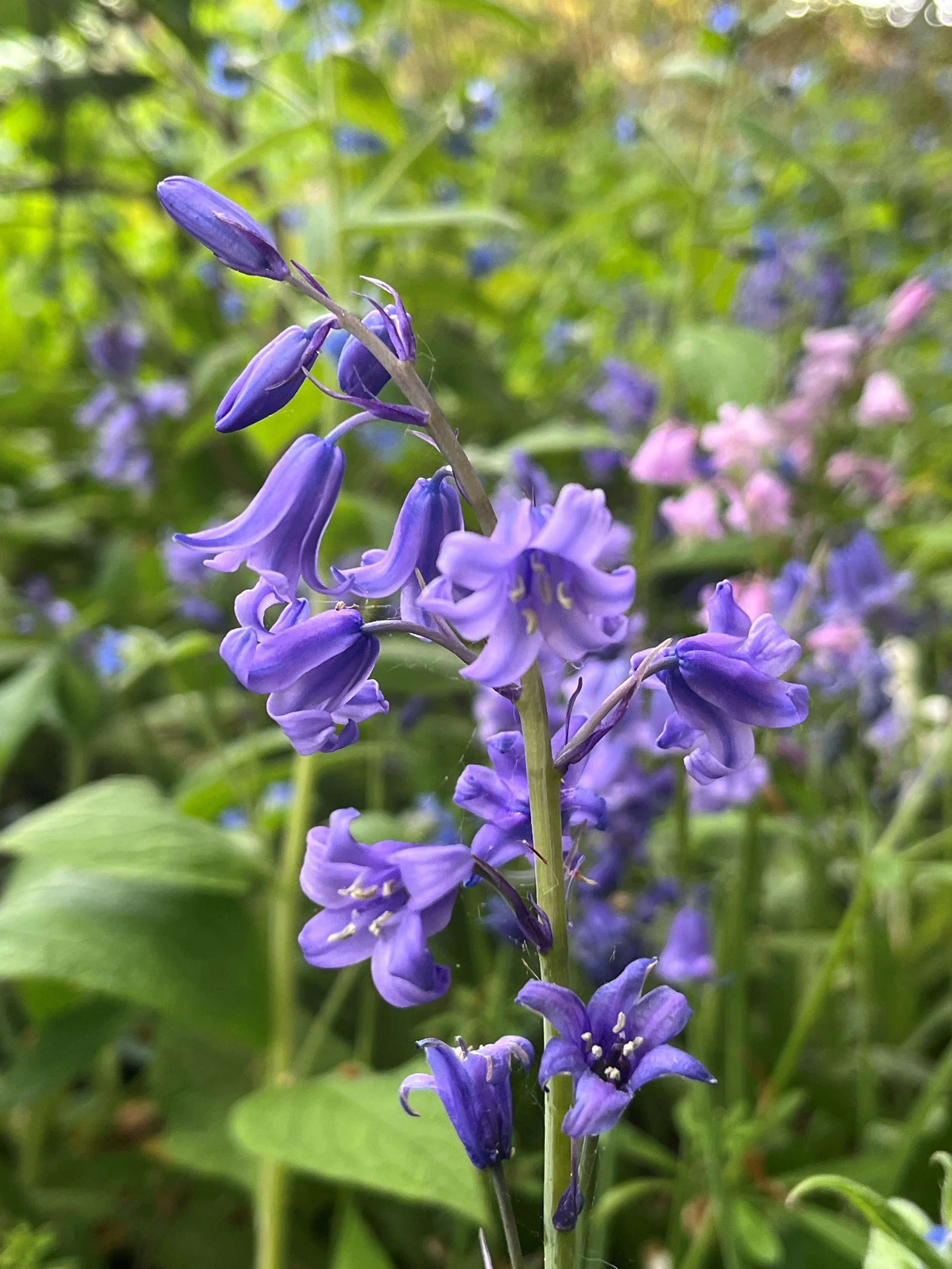
Flowering profusely in British woodlands, are the unmistakable and ever
popular Bluebell or Hyacinthoides non-scripta.
Native to Western Europe and the UK, they are usually associated with
ancient woodlands, however, they are quite often planted in gardens.
Otherwise known as the English bluebell or common bluebell, should not
be confused with the Scottish bluebell, which is in fact the harebell,
Campanula rotundifolia.
Some of you will be familiar with the Spanish bluebell, Hyacinthoides
hispanica with its more upright stems and wider leaves. This plant has
crossed with our native species, producing hybrids that are looked on as
invasive in the same areas with the result that our native bluebell is
regarded as a threatened species.
Amongst the many common names we have the wild hyacinth, cra’tae
(crow toes), Aul (old) mans bells (careful with pronunciation) and witches
thimbles.
Bluebells are of great value to native wildlife. Woodland butterflies, bees
and hoverflies all feed on the nectar. Bees can steal the nectar by biting
a hole in the bottom of the flower to reach the nectar.
The Bluebell is a symbol of humility, gratitude and everlasting love.
BEWARE!
One of the many common names is ‘Dead Men’s Bells’ and it is said that
it is very bad luck to hear a bluebell ring, as it is an omen of your own
death, and you will be visited by a bad faerie, with dire consequences
not long after!
It is also said that if you pick a bluebell, you will be led astray by a faerie.
(probably the same guy as above!).
Bluebells are protected by the Wildlife and Countryside Act, so it is
prohibited to dig up the plant or bulb and can take years to recover from
damage by being trampled on, so please be careful and enjoy the blue.
Alan Harvey